


Key points.
- New family business leaders are increasingly determined to have an “impact”: environmental and social sustainability is a key consideration in succession planning.
- Long-term success stems from a deliberate choice, not from the expectations of others. The next generation must explore the outside world before joining the family business.
- Family businesses are often distinguished by their flexible decision-making, a fundamental asset during periods of economic and political upheaval.
- Family businesses must combine tradition and modernity, preserving their identity, authenticity and values while decisively changing their business model to meet the challenges of a rapidly changing world.
The Swiss entrepreneurial landscape is entering a period of transition: it is estimated that a new management team will take over in 90,000 companies in the coming years 1. For family businesses, in which the change of management team is not only a practical aspect, but an emotional process involving family ties, identity and trust, this period can prove particularly delicate.
So, how can succession be planned to ensure long-term success? How can companies adapt to a rapidly changing world? And how will the next generation of leaders distinguish themselves from their predecessors?
The Swiss entrepreneurial landscape is entering a period of transition: it is estimated that a new management team will take over in 90,000 companies in the coming years.
These questions featured prominently at Generation Summit 2025, the first in a series of conferences dedicated to family businesses, organised by the renowned Swiss economic and financial newspaper Finanz und Wirtschaft .
This day, which recently took place in Zurich with the support of Lombard Odier – itself a family business, owned and managed by its Managing Partners for seven generations since its founding in Geneva in 1796 – brought together opinion leaders from the financial sector (including Nannette Hechler-Fayd’herbe, CIO EMEA and Head of Investment Strategy, Sustainability and Research at Lombard Odier) and leaders of major Swiss companies (including André Hoffmann, Vice President at Roche Holding Ltd and author of The New Nature Of Business , representing the fourth generation of the founding Hoffmann family, and Philipp Buhofer, Chairman of the Board at DAX Holding AG) and from an entrepreneurial lineage rooted in the Swiss industrial fabric, who explored the challenges faced by family businesses in times of economic and political volatility.
Finding one’s purpose
André Hoffmann, Vice President of the Swiss health giant Roche and member of the executive board of the World Economic Forum, stressed in his opening speech the importance of defining one’s “raison d’être”.
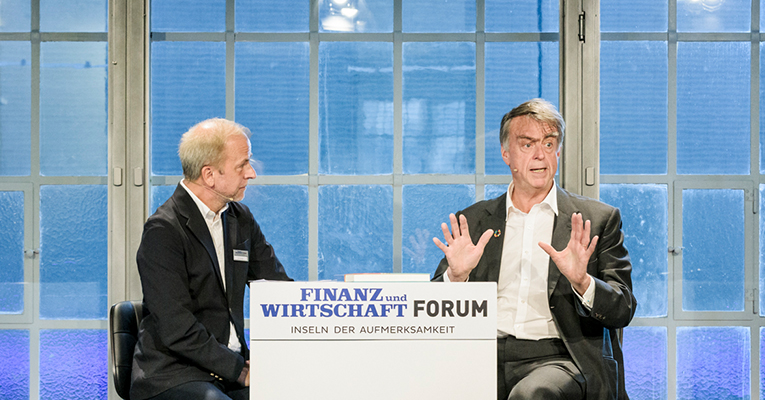 Jan Schwalbe, Editor-in-Chief of Finanz und Wirtschaft, and André Hoffmann, Vice President of Roche Holding AG, the family company, and Co-Chairman of the World Economic Forum
André Hoffmann recounted the unexpected call he received from a competitor in 2003, who offered to buy Roche outright. After a brief moment of reflection, he came to a very simple conclusion: “We refused. We wanted to maintain our independence.”
This unexpected offer was a revelation for André Hoffmann and his family. “We understood why we were there. We weren’t simply shareholders waiting to receive our dividends. Owning a part of the company […] means identifying with it, with what it is and what it does. We set ourselves a goal: ‘to do today what patients will need tomorrow.’ This has been a great help to the company and has strengthened our family ties. Every company absolutely must have a purpose.”
The way to have an impact
As the next generation prepares to assume its responsibilities, conference participants learned that a company’s purpose is now influenced by sustainability criteria, both environmental and social. Businesses are no longer seen simply as vehicles for wealth creation, but as a means of having a positive impact on the communities in which they operate, as well as on the wider world. Previously absent from the agenda, sustainability is now central to discussions about the next generation’s transition.
Businesses are no longer seen simply as vehicles for wealth creation, but as a means of having a positive impact on the communities in which they operate, as well as on the rest of the world. Sustainability, previously absent from the agenda, is now central to discussions about the transition for the next generation.
André Hoffmann explained that this broader objective can guarantee the longevity of a family business. “Then, you have to ask yourself how you can preserve your influence from one generation to the next. Sustainability isn’t just about ‘saving the animals.’ It’s about establishing a system that is constantly preparing for the arrival of new generations.”
“I would say that we shouldn’t look at companies solely from a financial perspective. We need to examine their impact on the three main forms of capital we all possess: human capital (people), social capital (the group we form), and natural capital (nature). Short-term success isn’t enough. For a family business that has to plan for several generations, today’s success must be repeatable again and again.”
Agility in the era of Donald Trump
However, how can companies achieve this goal in a political climate that has become unfavorable to sustainability strategies and investments? For Nannette Hechler-Fayd’herbe, the solution lies in Swiss innovation. “Human beings are made to seek solutions. That’s why I remain optimistic. Periods like the one we are going through stimulate innovation. And Switzerland has a strong capacity for innovation,” she stated.
Drawing a parallel with Donald Trump’s sudden imposition of 39% tariffs on Swiss exports to the United States, Ms. Hechler-Fayd’herbe stressed that Swiss companies have a long tradition of adaptation, evolution and agility.
“In 2015, when the Swiss National Bank removed the EUR/CHF exchange rate floor, our main export market became much more expensive overnight. Sixty percent of exporters were affected,” she explained. “This kind of situation fosters flexibility, as it requires exploring new markets. Today, faced with a less cordial relationship with the United States, we will turn to emerging markets, which represent the future of consumption for many product categories.”
Participants learned that, despite the reputation for conservatism sometimes attributed to family businesses, their private ownership structure and often flexible communication channels allow them to adapt more quickly to a changing environment.
Echoing the concept of agility mentioned by Ms. Hechler-Fayd’herbe, Tanja Zimmermann-Burgerstein, owner and CEO of Antistress AG-Burgerstein Vitamins, stated: “It takes courage to be flexible and continue to evolve as the truth changes. [In family businesses], to ensure continuity between generations, it is essential to ensure that long-serving employees remain with you. This is all the more important as the world moves faster and faster. Small businesses can often do this better than large ones, which are subject to rigid policies.”
In family businesses, ensuring continuity between generations requires that long-serving employees remain involved. This is all the more important as the world moves faster and faster. Small businesses are often better equipped to do this than large ones, which are subject to rigid policies.
Take the reins with determination
A round table discussion moderated by Marie-Christine von Pezold, Managing Director of the Family Business Network in Switzerland and family governance consultant at Lombard Odier, focused on another essential aspect of the long-term success of a family business: the autonomy of the next generation.
Participants learned that family business leaders can, consciously or unconsciously, exert emotional pressure on each new generation to set aside their own aspirations and fully commit to the company. According to Philipp Buhofer, President and CEO of Buru Holding, this is a mistake. “In my opinion, anything that endures and succeeds in the long term stems from freedom of choice. This is fundamental: nothing in life should be done under pressure. Before joining my company, I spent a few formative years at Metro Cash & Carry. External training is essential. You shouldn’t join a company solely because of family connections.”
Reto Candrian, CEO of the Candrian hospitality group, agrees. “I hadn’t planned on joining the family business,” he said. “I wanted to be as independent as possible. I didn’t train in the restaurant or hospitality industry, but went into finance. Why do I want to emphasize this? Because true independence, both financial and operational, was essential. In case of failure, I had a plan B. These are very solid foundations.”
Combining tradition and modernity
The roundtable discussion revealed that even the most successful transitions involve upheaval. While this is an integral part of the adaptability that every company needs, each new generation of leaders must understand and respect the company’s history and values.
Annemarie Widmer, owner and CEO of the Louis Widmer cosmetics and pharmaceutical group, explained: “Internally, we talk about ‘roots and wings.’ The ‘roots’ are our values, how we treat our employees and customers, and our brand promise, which we have maintained at the highest level of quality for many years. The ‘wings’ are the improvements that prevent us from resting on our laurels: adopting new technologies to exponentially increase our efficiency, or expanding our range of services. Family businesses are best positioned to achieve this, as our history goes back several generations.”
Throughout the day’s discussions, the speakers reiterated the key themes for the success of family businesses: agility and adaptability, the choices made by each new generation, and the need to unite around a shared purpose. They also emphasized the crucial importance of combining tradition and modernity, preserving the best of the family heritage while evolving business models and adapting them to a changing world.
Above all, you must be deeply passionate about your mission and adopt a long-term, intergenerational vision. This is what distinguishes a family business. By preserving this balance, you will guarantee its success from one generation to the next.
Marie-Christine von Pezold concluded by saying: “You absolutely must convey the ‘ why ’ of your company: your DNA, your values, and your philosophy. This is a true mark of authenticity and identity. The ‘ what ’ (the company itself) must adapt. Be bold in this regard. Above all, you must be deeply passionate about your mission and adopt a long-term, intergenerational vision. This is what distinguishes a family business. By preserving this balance, you will guarantee its success from one generation to the next.”