



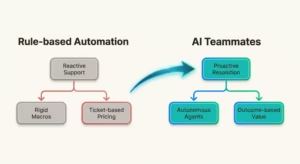
Most eCommerce support services pass the demo but fail in the inbox, automating simple order tracking but getting stuck on anything related to billing history. We tested 14 tools on a backlog of live Shopify tickets, and only six made it past level 1—a stark reminder of how far the eCommerce support landscape has come since the days of simple ticket triage. Gorgias has long been a mainstay for Shopify brands, but its limitations become harder to ignore as stores scale: paying a “success tax” on every ticket and relying on rigid macros has become a bottleneck for growth, and brands are increasingly swapping reactive support services for proactive AI teammates that resolve issues end-to-end instead of just routing them.
What is Gorgias?
Gorgias has traditionally positioned itself as the default helpdesk for Shopify merchants. Its main selling point is the ability to manage Shopify orders directly from the support inbox. For startups and mid-sized brands, this tight integration makes it an easy starting point for handling basic customer requests.
Gorgias’ core functionality includes a centralized inbox for multichannel support and simple automation rules for managing repetitive tasks. It excels at displaying agent order history and follow-up information without requiring users to switch tabs. However, as support operations mature, teams often find that the ticket-based pricing model and the emphasis on diverting rather than resolving issues can hinder operational efficiency.
Why eCommerce teams are looking for alternatives to Gorgias in 2026
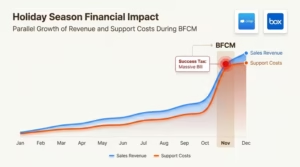
The search for the best alternatives to Gorgias often begins when a brand reaches what we call the “success tax.” Since Gorgias charges per ticket, your support costs increase in direct proportion to your sales. During peak periods like BFCM, this can result in a massive bill that hinders your growth.
Beyond cost, there’s a technical gap. Rule-based macros are reactive. They can tell a customer where their package is, but they struggle with complex, multi-step problems, like processing a partial refund or updating a subscription based on specific logic. Modern teams are turning to AI teammates that solve problems autonomously.
Finally, the depth of reporting depends heavily on the pricing tier you choose. Gorgias’ pricing page shows that revenue statistics—the metric most growing teams want—are only included in the Pro and Advanced plans, while lower tiers are limited to basic support performance metrics. When you’re maximizing unit savings and long-term resolution rates, you need a platform that treats support as a data-driven growth channel rather than a cost center.
Selection criteria for an alternative to Gorgias
Choosing the right platform isn’t just about ticking a list of features. It’s about understanding how the tool fits into your broader technology stack. Here’s what we looked for during our testing:
- Integration depth: The tool must have a native and deep connection with Shopify, WooCommerce, or Magento. It must be able to perform actions such as processing refunds or modifying orders, and not just read data.
- Automation model: We prioritized tools focused on resolution rather than simple redirection. A good AI agent should be able to close the loop without a human ever having to touch the ticket.
- Predictable pricing: We looked for models that don’t penalize growth. Whether based on the number of seats or usage, costs must be transparent and scalable.
- Learning speed: A support tool shouldn’t take months to set up. We favored solutions that can learn your brand’s voice and policies in minutes by reading your existing documentation and ticket history.
How we conducted this comparison of the best alternatives to Gorgias
To make this comparison useful, we evaluated each tool using a consistent set of criteria. Here’s what we looked for:
- Quality of results: Were the content and response well-written? Did they sound human or were they clearly generated by a bot?
- Ease of use: How quickly could we get started? We preferred tools with simple interfaces that did not require engineering resources.
- Feature set: Did the tool offer more than just ticket management? We looked for proactive engagement, CRM capabilities, and advanced AI.
- Value for money: Was it worth the cost? We compared the price to the actual resolution results obtained.
Comparison of the 6 best alternatives to Gorgias in 2026
| Tool | Ideal for | Pricing model | Key advantage |
|---|---|---|---|
| eesel AI | Standalone resolution | Pay-as-you-go | Learn in minutes, 80%+ solver |
| Zendesk | Enterprise scale | By agent | Massive ecosystem and reporting |
| Kustomer | Unified context | Per agent/Result | CRM Single Customer Timeline |
| Freshdesk | Ease of use for SMEs | By agent | Affordable with an intuitive user interface |
| Help Scout | Personal touch | Per user | Human-centered shared inbox |
| Re:amaze | Multichannel chat | Per seat/Package | Live dashboard and eCommerce depth |
6 Best Alternatives to Gorgias for eCommerce Support
1. eesel AI
We designed eesel AI to be more than just a helpdesk. It’s an AI teammate you can “hire.” Most AI tools are black boxes you turn on and hope for the best. With our platform, you don’t configure it, you hire it. Like any new team member, it learns your business, starts with guidelines, and grows to work autonomously. What typically takes a human weeks to master, our helpdesk agent learns in minutes.
eesel AI connects to your existing stack (Zendesk, Shopify, Slack, etc.) and absorbs your old tickets, macros, and help center articles. This allows it to manage end-to-end front-line support with a 94% match to your brand voice from day one. It doesn’t just suggest answers; it can take real actions like processing refunds or updating shipping addresses via API.
| Plan | Price | Key features |
|---|---|---|
| Regular | $0.40 per task | Support tickets or chat sessions, no platform fees |
| Intensive | $4.00 per task | Blog post drafts with SEO research |
| Business | $2,100/month | Compliance, SSO, HIPAA, dedicated account manager |
Benefits :
- Learns from years of ticket history from day one.
- Pay only for results resolved, with no monthly minimum or per-seat fees.
- Includes a $50 free trial with all features unlocked.
Disadvantages:
- The emphasis is on the autonomy of the AI; this could be excessive for teams wanting simple manual ticket management.
- Charged for tasks even if the results require human correction.
During the first month, eesel resolved 73% of our level 1 requests. Easy Zendesk implementation.
2. Zendesk
Zendesk is the enterprise-grade giant in the customer service space. It’s a highly scalable platform that offers a vast marketplace with over 1,800 applications. For brands that have moved beyond the purely Shopify approach, Zendesk provides a robust infrastructure for managing complex omnichannel interactions across email, chat, social media, and voice.
Their AI agents are designed to reason and take independent actions, although they often require more manual configuration than smaller competitors. The platform also offers an agent copilot that provides real-time assistance and suggested responses to human representatives.
| Plan | Annual price (per agent) | Key features |
|---|---|---|
| Suite Team | $55/month | Basic AI agents, messaging, telephony |
| Professional Suite | $115/month | HIPAA compliance, skills-based routing |
| Enterprise Suite | $169/month | Sandbox, audit logs, 300 help centers |
Benefits :
- Extensive marketplace for custom integrations.
- Advanced reporting and workforce management.
- Qualified startups can benefit from 6 months free.
Disadvantages:
- High configuration complexity compared to eCommerce-specific tools.
- Automated resolutions are billed as add-ons ($1.50 to $2.00 each) after a small inclusion fee.
3. Kustomer
Kustomer is a CRM-focused platform that unifies customer data into a single timeline. Instead of viewing individual tickets, agents see a complete history of every interaction, purchase, and event. This makes it a serious contender for brands that prioritize customer context over ticket numbers.
The platform includes built-in AI agents and Kustomer AI for reps , which provides instant answers from knowledge bases and automatic record updates. It is particularly well-suited for high-growth brands that need intelligent orchestration of their customer journeys.
| Plan | Pricing | Key inclusions |
|---|---|---|
| Kustomer AI | Contact sales | Deploy AI agents into the existing stack |
| Kustomer AI + Platform | Contact sales | Complete CRM platform, 300 languages |
Benefits :
- The unified customer timeline provides in-depth context for every conversation.
- Intelligent orchestration routes customers based on intent in real time.
- No success tax on basic ticketing.
Disadvantages:
- Opaque pricing requires a sales demonstration.
- Steep learning curve and longer implementation times.
4. Freshdesk
Freshdesk is an affordable alternative that emphasizes simplicity and ease of use. It’s a great compromise for growing teams that need more than just an inbox but aren’t ready for a full enterprise setup. Their AI assistant, Freddy AI agent , helps automate repetitive chat and email queries.
Freshdesk’s pricing is competitive for small businesses, and they even offer a free 6-month plan for very small teams. It includes essential features like shared inboxes, knowledge bases, and ready-to-use basic reports.
| Plan | Annual price (per agent) | Key features |
|---|---|---|
| Growth | $19/month | Ticketing, shared inbox, reports |
| Pro | $55/month | Custom objects, advanced routing |
| Enterprise | $89/month | Audit logs, skills-based assignments |
Benefits :
- Quick integration and intuitive user interface.
- Co-pilot Freddy AI dedicated to assisting agents.
- Affordable entry levels for SMEs.
Disadvantages:
- Advanced features are locked behind the higher Enterprise tier.
- Freddy AI Agent sessions cost $49 per 100 sessions after initial enrollment.
5. Help Scout
Help Scout is designed for teams that want support to remain human. It replaces the traditional ticketing system feel with a shared inbox that resembles a regular email thread. This makes it a favorite for brands that prioritize customer relationships and a personal touch.
Their AI Answers feature acts as an autonomous agent that resolves customer requests using your Docs help center . Its adoption is remarkably easy, with Help Scout stating that users can become “power users” in less than a day.
| Plan | Annual price (per user) | Key limitations |
|---|---|---|
| Standard | $25/month | 2 inboxes, 2 Docs sites |
| More | $45/month | 5 inboxes, 3 Docs sites, Salesforce/Jira |
| Pro | $75/month | 10 inboxes, HIPAA compliant, SSO |
Benefits :
- A clean and uncluttered interface that requires almost no training.
- Excellent AI resolution rates (average of 73%).
- Transparent pricing based on the number of seats.
Disadvantages:
- Limited advanced automation for very high-volume stores.
- AI resolutions cost an additional $0.75 each on a monthly basis.
6. Re:amaze
Re:amaze is designed specifically for eCommerce teams that need a unified view of customer purchase data without the complexity of an enterprise CRM. It offers deep integration with Shopify, WooCommerce, and BigCommerce, allowing agents to see order history and status directly in the Re:amaze inbox .
A notable feature is Peek , which allows agents to see customer obstacles and perform predictive text input in real time. Their AI agent is trained on your FAQ center and can provide personalized support 24/7.
| Plan | Monthly price | Key inclusions |
|---|---|---|
| Basic | $29 (per seat) | Live chat, 20 AI resolutions/user/month |
| Pro | $49 (per seat) | Multi-brand, SMS, 50 AI resolutions/user/month |
| More | $69 (per seat) | Peek co-navigation, video calls, 100 AI resolutions/user/month |
Benefits :
- Real-time eCommerce intelligence displays order data in the chat thread.
- The Peek feature allows you to see what customers are doing in real time.
- Easy setup with pre-built bots for tracking and commands.
Disadvantages:
- Basic reporting and fewer integrations than Gorgias or Zendesk.
- The overage fees for AI resolutions are $0.85 each.
Tips for choosing the right support tool for your store
Before embarking on a migration, you should first identify your bottleneck. Is it volume, complexity, or cost? If you’re overwhelmed by simple FAQs, you need an AI teammate who prioritizes resolution over deflection. If your team struggles to keep track of customer history, a CRM-centric approach is preferable.
We also recommend testing with real data using simulations. Most tools look great in a demo with a single test ticket. The real test is seeing how they handle 500 diverse tickets from your actual backlog. Does the AI grasp the nuance of a refund request? Does it correctly identify a VIP customer?