



Most help desk services start as simple inboxes and end up becoming complex labyrinths of manual tagging and forgotten emails. We tested 14 support platforms against three key growth criteria: depth of automation, price transparency, and AI-powered resolution accuracy. Only seven of them kept pace with the increased workload.
What is Help Scout? (And why do teams end up feeling cramped there?)
Help Scout has long been the “friendly” face of customer support. It’s designed to make support feel more like a personal email than a ticket number, which is why small teams love it. It’s simple, clean, and avoids the clutter of traditional enterprise tools.
However, this simplicity is a double-edged sword. As your volume increases, cracks begin to appear:
- Manual processes: You end up performing the same marking and routing tasks over and over again because automation is not advanced enough.
- Reporting limitations: As soon as you need to segment data by custom variables or complex team structures, Help Scout’s analyses can seem somewhat limited.
- The AI ceiling: Help Scout has introduced AI, but it often acts more as a “summarizer” or “co-pilot” for your agents than as a true colleague capable of autonomously resolving tickets.
If you’re spending more time managing your inbox than talking to your clients, it might be time to switch to something more robust.
Criteria for choosing the best alternatives to Help Scout
When examining the market for 2026, we weren’t just looking for “more features.” We were looking for tools that address the specific pain points of a growing support team. Our criteria included:
- Native AI autonomy: We favor tools where AI can actually solve the problem, and not just suggest an answer for an agent to click on.
- Omnichannel support: Support happens everywhere today – social media, email, chat, and even WhatsApp. Your tool needs to centralize everything.
- Transparent pricing: We favor usage-based models or clear per-seat pricing, rather than the opaque traps of “enterprise” quote-based versions.
- Deep integrations: Particularly for SaaS and e-commerce, your helpdesk needs to see what’s happening in Shopify, Stripe, or your internal database.
Comparison of the seven best alternatives to Help Scout
| Tool | Main strength | Starting price | Ideal for |
|---|---|---|---|
| eesel AI | Standalone resolution | $0.40/ticket | Growing teams |
| Zendesk | Company Depth | $19/agent | Major operations |
| Forehead | Team collaboration | $25/seat | Collaborative inboxes |
| Freshdesk | Scalability & free version | $0 | Startups & SMEs |
| Gorgias | E-commerce Focus | $10/month | Shopify stores |
| HappyFox | Custom automation | $21/agent | Process-oriented teams |
| Crisp | Simple live chat | $0 | Startups |
eesel AI
eesel AI is the next-generation colleague that learns your business in minutes. Instead of simply helping your agents work faster, it acts as a full-fledged team member.
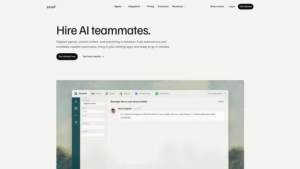
It connects to your existing documentation, past tickets, and help center articles to learn your communication style. Within minutes, it’s ready to resolve front-line tickets autonomously, while respecting your voice and tone.
Key features:
- Autonomous resolution: It handles the bulk of the front-line work so your team can focus on complex, high-value conversations.
- Multichannel: Whether by email or chat, AI is ready to respond.
- Usage-based pricing: You only pay for what the AI actually does.
Pricing: I love honest pricing, and eesel keeps it simple: $0.40 per ticket/chat session, $4.00 per blog post, with a $50 free trial (no monthly minimums or platform fees). Plus, you can see the magic happen for yourself, without having to pull out your credit card.
Advantages & Disadvantages:
- Instant setup: It learns from your existing documents without a month-long implementation phase.
- No per-seat fees: You are not penalized because your team is growing.
- Limited legacy features: This is a tool designed primarily for AI, so if you’re looking for a 90s-style ticket interface with 400 buttons, this may not be for you.
Zendesk
If Help Scout is the friendly neighborhood shop, Zendesk is the global supermarket. It’s the industry standard for a reason: it can do absolutely everything.
Zendesk is built for scale. It offers incredibly detailed reporting, a massive app marketplace, and advanced routing capable of handling thousands of agents across multiple regions. By 2026, their “Suite” plans include essential AI capabilities to automate repetitive tasks.
Key features:
- Advanced analytics: The reporting is best-in-class, allowing you to segment data in almost every conceivable way.
- Omnichannel: It centralizes everything from email and voice to social media messaging.
Pricing: Prices start at $19 per agent/month for the Support Team plan, but most growing teams will prefer the Suite Team plan at $55 per agent/month (billed annually) for access to AI features. Professional tiers go up to $115 per agent/month.
Advantages & Disadvantages:
- In-depth features: You will never be limited by this tool.
- Steep learning curve: It’s complex. You’ll likely need a dedicated administrator to configure and maintain it.
Forehead
Front is designed for teams that like the look of Help Scout but need better collaboration. It’s a shared inbox that resembles a supercharged version of Gmail.
The magic of Front lies in the “behind-the-scenes” collaboration. You can @mention colleagues on a ticket to discuss internally before responding to the client, and you can share drafts to get a second opinion on a complex response.
Key features:
- Real-time collaboration: Internal comments and shared drafts allow everyone to be on the same page.
- Intuitive interface: If your team knows how to use email, they know how to use Front.
Pricing: The Starter plan is $25 per seat/month (up to 10 seats). For omnichannel support and more automation, you’ll need the Professional plan at $65 per seat/month (billed annually).
Advantages & Disadvantages:
- Excellent user experience: The interface is fast and familiar.
- Costly on a large scale: Since you pay per seat, the bill can climb very quickly as you recruit.
Freshdesk
Freshdesk is the great “all-rounder”. It’s feature-rich, relatively easy to use, and offers one of the most generous free plans in the industry.
It’s a perfect stepping stone for teams who feel constrained by Help Scout but aren’t ready for the complexity of Zendesk. It includes unique features like gamification, where agents earn points by resolving tickets, boosting morale during busy weeks.
Key features:
- Freddy AI: Their AI robot can help with both customer-side chat and agent productivity.
- Solid free version: Ideal for very small teams just starting out.
Pricing: Freshdesk offers a free plan for up to 10 agents. Paid plans start at $19 per agent/month for the Growth tier and $55 per agent/month for the Pro tier (billed annually).
Advantages & Disadvantages:
- Scalable: It comfortably accommodates you from 2 agents to 200.
- Cluttered interface: Because it tries to do a lot, some features may end up buried in deep menus.
Gorgias
If you run a Shopify or BigCommerce store, Gorgias is almost certainly the Help Scout alternative you need.
Gorgias is designed specifically for e-commerce. It pulls your customer’s entire order history, tracking information, and even their loyalty points directly into the ticket sidebar. You can refund orders or modify subscriptions without ever leaving your helpdesk.
Key features:
- Deep e-commerce integrations: View and edit Shopify orders directly within the ticket.
- Revenue tracking: It shows you exactly how much money your support team generates from sales.
Pricing: Gorgias uses a volume-based model with unlimited seats. The Starter plan is $10/month (50 tickets), the Basic plan is $50/month (300 tickets), and the Pro plan starts at $300/month (2,000 tickets). Their AI Agent is an add-on at $0.90 per resolved conversation.
Advantages & Disadvantages:
- The best thing about Shopify: The depth of integration is unmatched in the retail industry.
- Niche focus: If you are a SaaS company, many of the best features (like order modification) will be of no use to you.
HappyFox
HappyFox is the workhorse of helpdesks. It is robust, highly customizable, and focused on process automation.
If your team has highly specific and complex workflows, such as managing physical assets or multiple brands from a single location, HappyFox is designed for that level of detail. It’s more like a “process management” tool than a simple inbox.
Key features:
- Asset management: Track hardware and licenses along with your support tickets.
- Multi-brand support: Manage different brands with unique portals from a single instance.
Pricing: HappyFox’s prices start at $21 per agent/month on their 2-year savings plan for the Basic tier. The very popular Pro tier is $89 per agent/month.
Advantages & Disadvantages:
- Highly customizable: You can adapt the fields and processes to fit almost any internal procedure.
- Opaque pricing: The website displays a 2-year commitment by default, and it can be difficult to find simple monthly rates.
Crisp
Crisp is an all-in-one messaging platform that is particularly popular with startups and small businesses that swear by live chat.
It’s simpler than Help Scout in some ways, but more powerful in others. It includes an integrated CRM, a knowledge base, and even a campaign tool for sending proactive messages to your users. It’s perfect if you want to keep your tech stack lightweight and affordable.
Key features:
- Unified Messaging: Centralizes chat, email, and social media messages.
- Flat rate: They do not charge per seat, which is a real breath of fresh air.
Pricing: Crisp offers a free plan for 2 seats. The Mini plan is $45/month (4 seats) and the Essentials plan is $95/month (10 seats). The Plus plan is $295/month for 20 seats or more.
Advantages & Disadvantages:
- Affordable: The flat-rate model makes the budget very predictable.
- Lack of depth for ticketing: It does not have the advanced SLA management or complex ticket routing of larger tools.
Choosing the right tool for your team
Choosing an alternative to Help Scout depends on the direction your team is taking:
- If you want to automate your front line: eesel AI is the clear winner for teams that want to grow without massive recruitment.
- If you are an e-commerce brand: Gorgias is the absolute reference for Shopify stores.
- If you need “enterprise” power: Zendesk remains the safest bet (albeit the most expensive) for large-scale operations.
- If you need a shared inbox for a small team: Crisp or Front will keep things smooth and collaborative.