


rtificial intelligence is transforming the financial landscape, and FinGPT is one of the most promising innovations. Its open-source model allows for the analysis of market data, the prediction of trends, and the optimization of investments with unprecedented accuracy. But what makes it different, and why could it change the way markets operate?
Table of Contents
What is FinGPT and what does its revolution mean?
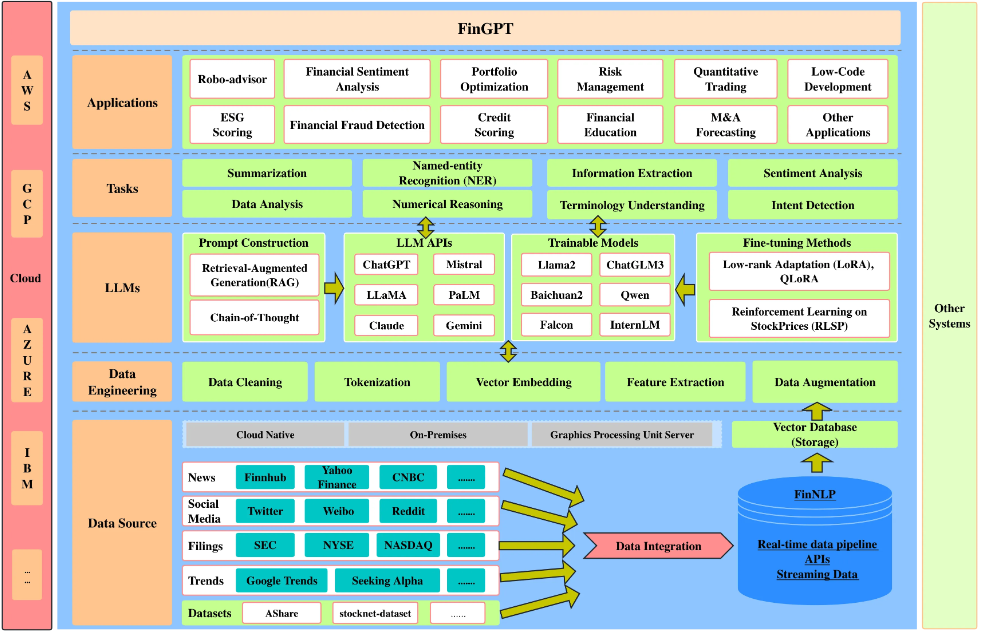
FinGPT is a language model designed specifically for financial analysis. Based on advanced artificial intelligence and deep learning architectures , it allows for the processing of large volumes of financial data in real time, integrating information from diverse sources such as news, social media, market trends, and regulations.
What sets FinGPT apart is its ability to be flexibly trained and tuned, allowing customizations to meet the specific needs of investors, financial institutions, and developers.
Key applications of FinGPT
From process automation to trading strategy optimization, FinGPT offers multiple use cases:
- Sentiment analysis in the markets : You can assess the impact of news and opinions on social media on financial assets in real time.
- Financial trend prediction : Uses machine learning models to detect patterns in market data.
- Risk and fraud manager : Identifies anomalies and prevents fraud through automated analysis.
- Portfolio optimization : Helps make investment decisions based on historical data and predictions.
- Automation of financial tasks : From report generation to credit evaluation.
FinGPT Architecture: What’s Under the Hood
FinGPT is based on a multi-layered ecosystem that includes:
- Language Models ( LLMs ) : Integrating ChatGPT, LLaMA, Mistral and other models for advanced natural language processing.
- Vector databases : Facilitate the efficient storage and access of structured and unstructured information.
- Diverse data sources : From news and social media to regulatory files and market trends.
- Fine-Tuning methods : Such as LoRA and RLSP, which optimize models for specific tasks in the financial world.
The impact of FinGPT on the financial industry
FinGPT’s flexibility and power allow it to be applied in banks, hedge funds, fintechs, and even retail investment platforms. Its open-source nature enables collaboration, similar to deepseek , and continuous improvement of the model, making it accessible to a global community of developers and analysts.
With the growth of financial data and the need to interpret it quickly, tools like FinGPT are becoming essential for data-driven decision making.
FinGPT marks a turning point in artificial intelligence applied to finance . With its analytical, predictive, and optimization capabilities, financial markets will be able to operate with greater efficiency and precision. The AI-powered financial revolution is here, and FinGPT is the engine driving it.