

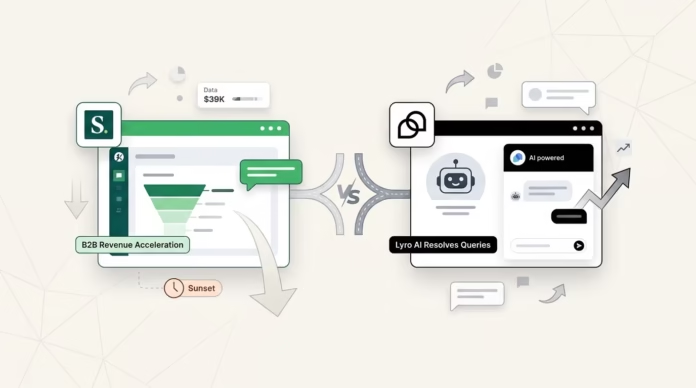

If your team prioritizes accelerating high-end B2B revenue, Drift has been the standard choice, but with reports announcing its transition in 2026, the decision has changed. Tidio’s Lyro AI now solves up to 67% of queries for SMBs, creating a new segment in the market. Full comparison below.
The landscape of website communication has changed dramatically since the days of simple chat boxes. Today, choosing between Drift and Tidio is no longer simply about which widget looks best on your site. It’s a decision about whether you’re optimizing for business sales cycles or for effective customer support at scale.
For many teams, the news of Drift’s transition transformed a standard comparison into an urgent search for a long-term partner. While Drift continues to dominate B2B pipeline acceleration, Tidio has made significant strides in making sophisticated AI accessible to small and medium-sized businesses. We’ve analyzed the feature sets, pricing models, and automation capabilities of both platforms to help you navigate this transition.
What is Drift?
Drift pioneered the “conversational marketing” category with a clear focus on revenue. Instead of waiting for a customer to submit a form and hoping a sales rep will follow up within 24 hours, Drift enables real-time lead qualification. The platform was designed from the ground up to shorten B2B sales cycles and accelerate the pipeline by connecting high-intent visitors directly with the right sales reps.
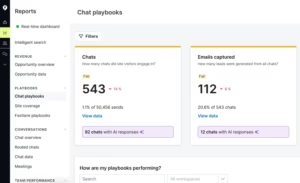
The platform is designed for complex organizations where the sales process involves multiple stakeholders and account-based marketing (ABM) strategies. Features like Drift Prospector provide in-depth insights into target accounts, showing exactly when a key prospect is on your site and what they are viewing. This allows sales teams to prioritize their prospecting based on real behavioral data rather than guesswork.
However, the most significant context for any comparison between Drift and Tidio in 2026 is the recent acquisition by Salesloft. Reports have surfaced indicating that Drift is undergoing a transition in 2026 , with its core technology being more deeply integrated into the broader Salesloft ecosystem. For existing customers, this means a shift in focus toward “connected modern workflows” rather than a standalone chat solution. For potential buyers, it means considering whether a platform in transition is the best choice for their long-term growth.
The key enterprise features that define the Drift experience include:
- ABM targeting , which identifies high-value accounts as soon as they arrive on your site and welcomes them with personalized messages
- Sales sequences , which automate follow-up based on chat interactions to keep leads moving through the funnel
- Meeting scheduling , which integrates directly with sales representatives’ calendars to book demos without a single email exchange.
- Drift Intel , which automatically qualifies prospects by extracting third-party data to verify company size and industry
What is Tidio?
While Drift targets the high-end B2B market, Tidio has established itself as the leading all-in-one customer service platform for small and medium-sized businesses (SMBs) and e-commerce stores. It’s designed for accessibility, ease of use, and rapid setup, allowing businesses to launch a professional chat presence in minutes rather than weeks.
The centerpiece of Tidio ‘s modern offering is the AI Lyro. Unlike traditional chatbots that require you to manually map out every possible question and answer, Lyro uses natural language processing to understand customer intent. It can crawl your website or help center and begin automatically responding to up to 67% of customer queries. This level of automation is a significant advantage for lean teams that can’t afford to have a human agent online 24/7.
Tidio is particularly well-suited for e-commerce, offering deep native integrations with platforms like Shopify and WooCommerce. This allows agents to view customer order history, track shipments, and even recommend products directly within the chat interface. It’s a support-focused tool that proves highly effective for lead generation, making it a versatile choice for businesses that need to manage both inquiries and sales.
The main features that make Tidio a strong competitor in the comparison between Drift and Tidio include:
- Lyro AI Agent , a conversational bot that answers questions in natural language based on your existing support content
- A multi-channel inbox that manages WhatsApp, Instagram, and Facebook Messenger conversations in a single workspace.
- Flux Tidio , a visual bot builder that uses drag-and-drop logic to automate routine tasks like lead qualification
- Order management , which allows you to view and manage customer orders from the chat widget without changing tabs.
Feature comparison: Drift Playbooks vs. Tidio Flux
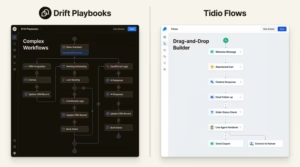
When you examine the automation capabilities of Drift and Tidio, you’re comparing two different philosophies of customer interaction. Drift uses “Playbooks,” which are sophisticated, multi-step workflows designed to guide a visitor toward a specific sales outcome, such as booking an appointment or downloading a white paper. Tidio uses “Flows,” which are visual automation paths focused on resolving support issues and capturing basic lead information.
Drift’s Playbooks are powerful but complex. They require careful planning to configure correctly, as they often involve branching logic based on CRM data, company size, and visitor behavior. For example, a Playbook might recognize a visitor from a target account and trigger a personalized welcome message from their dedicated account manager. This depth of personalization is why Drift remains a favorite among enterprise B2B teams, with deep integrations with Salesforce and Marketo.

In contrast, Tidio Fluxes are designed for speed and simplicity. The visual editor makes it easy to grasp the logic of a conversation at a glance. While it doesn’t have the same level of enterprise-grade ABM logic as Drift, it excels at common support tasks. A typical Flux can handle order tracking, provide shipping updates, or collect an email address for newsletter signup. For an e-commerce business on Shopify, the “out-of-the-box” nature of Tidio Fluxes is often more valuable than Drift’s complex CRM-based logic.
Here is a breakdown of how the two platforms compare in the main categories:
| Category | Drift | Tidio |
|---|---|---|
| Main objective | Revenue and sales pipeline | Support and growth of SMEs |
| Automation tool | Playbooks (Logic-focused) | Stream (Visual/Code-free) |
| main AI | AI Drift Conversation | AI Agent Lyro |
| Key integrations | Salesforce, Marketo, 6sense | Shopify, WordPress, WhatsApp |
| Learning curve | High (Requires effort) | Low (Rapid implementation) |
The choice between these two largely depends on your technology stack. If your business lives and breathes Salesforce and you need to prioritize high-value accounts, Drift has the infrastructure to support it. If you manage an online store or a growing support team that needs to resolve tickets on social media channels, Tidio offers a simpler path to success.
Pricing breakdown: Transparent tiers vs. corporate contracts
Drift and Tidio’s pricing models are as different as their feature sets. Tidio is known for its transparency and accessibility, offering a permanent free plan and clearly defined paid tiers that scale with your business. Drift, on the other hand, has moved almost entirely to a custom enterprise model, with opaque pricing that typically starts around $2,500 per month and requires annual contracts.
Tidio’s pricing is based on “billable conversations” and specific feature sets. This allows small teams to start for free and only pay as their volume increases. Their Growth plan, starting at around $49 per month, includes advanced analytics and brand removal, making it a favorite for growing e-commerce brands.
| Plan | Tidio Price | Drift Price | Ideal for |
|---|---|---|---|
| Free | $0 | Not available | Basic tests and chat |
| Starter | $29/month | On request | Start-up SMEs |
| Growth / Premium | $49/month | ~$2,500/month (Estimated) | Growing Brands / Company |
| Customized / More | Starting at $749/month | Customized contract | High-volume organizations |
Drift’s pricing can be a barrier for many organizations. While there is a “Starter” plan for startups, most businesses will find themselves on the enterprise tiers. These plans are typically based on the number of users, and additional seats can cost around $80 per month each. Considering the annual billing requirement, the initial investment for Drift is significantly higher than for Tidio.
For a business owner, calculating ROI is straightforward. Tidio offers great value for basic support and lead capture efficiency at a price that fits within a monthly budget. Drift offers a premium sales acceleration engine designed to justify its higher cost by increasing the “success rate” of high-value deals. However, with the news of Drift’s transition, many teams are questioning whether that high price is worthwhile for a product that is currently transitioning to a broader platform.
The modern alternative to the teammate
As the Drift vs. Tidio debate continues into 2026, a third category has emerged that is a complete game changer. Most chat platforms are “software you configure,” as you spend weeks setting up logic trees, writing pre-recorded responses, and mapping out every possible customer turn. We take a different approach with tsresolve.com . You don’t configure our AI; you hire it.
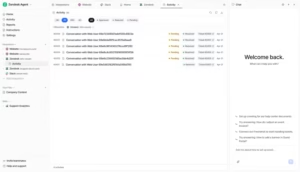
Like a human teammate, our AI joins your workspace and learns about your business in minutes. It doesn’t just read your help center; it absorbs your past ticket history, internal documentation, and even your Slack conversations to understand exactly how your team operates. While Tidio’s Lyro is a big step toward automation, we’re going further by incorporating years of real-world human interaction into the AI’s knowledge base.
We believe the future of customer communication is autonomous, not just automated. That’s why eesel AI doesn’t just write responses; it can manage the entire front-line support experience from end to end. It triages tickets, updates CRM fields, and even processes refunds by connecting to your existing tools via API. If it encounters a complex request it hasn’t seen before, it intelligently redirects it as a draft for human review, learning from your changes to improve next time.
Here’s why our AI support agent is becoming the preferred choice for teams moving away from Drift’s enterprise complexity:
- Get hired in minutes , because we connect to Zendesk, Freshdesk, HubSpot, and Gorgias, learning your entire business context without any manual training.
- It works where you work , because we don’t force you to use a new dashboard. Our AI lives within your existing help center or Slack, providing support exactly where your customers and team are.
- Trainable intelligence , which means that instead of complex decision trees, you give us instructions in plain language, just as you would with a human employee.
- Transparent, usage-based pricing , because we don’t believe in user-based fees or platform minimums. You pay for what the AI actually does.
Our pricing is designed for the modern era of transparent SaaS. We charge a flat fee of $0.40 per ticket or chat session processed. There are no monthly platform fees, no per-user costs, and no annual contracts required. If your volume is low, your bill is low. If you’d like us to manage the content, we can also write your blog posts for $4.00 each .
As Drift enters its transition phase in 2026, many teams are looking for a future-proof solution that doesn’t involve the overhead of a legacy enterprise platform. We’re offering a free $50 trial with all features unlocked, allowing you to “hire” our AI and see the results before committing a single dollar of your budget.
Final verdict: Which one to choose in 2026?
The choice between Drift and Tidio ultimately depends on your primary business objective. In 2026, the lines have never been clearer.
Choose Drift if you’re a large B2B organization with a high average contract value and a sophisticated sales operation already integrated with Salesloft or Salesforce. If your primary focus is account-based marketing and you have the budget for a premium strategic solution, Drift’s Playbooks and Prospector tools remain the gold standard for revenue acceleration. Just be prepared for the transition as the platform evolves within the Salesloft ecosystem.
Choose Tidio if you’re an SMB or e-commerce brand that needs to balance efficient support with lead generation. Tidio’s Lyro AI offers incredible value for businesses looking to automate their front-line support without needing a technical team to set it up. Its native Shopify integration and multi-channel inbox make it the most convenient choice for growing online stores that need to be present wherever their customers are.
But if you’re tired of configuring software and want a solution that works like a member of your team, we invite you to try eesel AI . We offer the enterprise-grade intelligence of a leading sales tool with the ease of setting up in minutes like a modern support application. Whether you need a standalone agent to manage your Zendesk tickets or a teammate to scale your content production, we offer a seamless, usage-based approach.
The landscape of 2026 is focused on autonomy and intelligence. Whether you choose the sales power of Drift, the support efficiency of Tidio, or the “hired teammate” model of eesel AI, the goal is the same: to offer a faster and more human experience to every visitor on your site.